
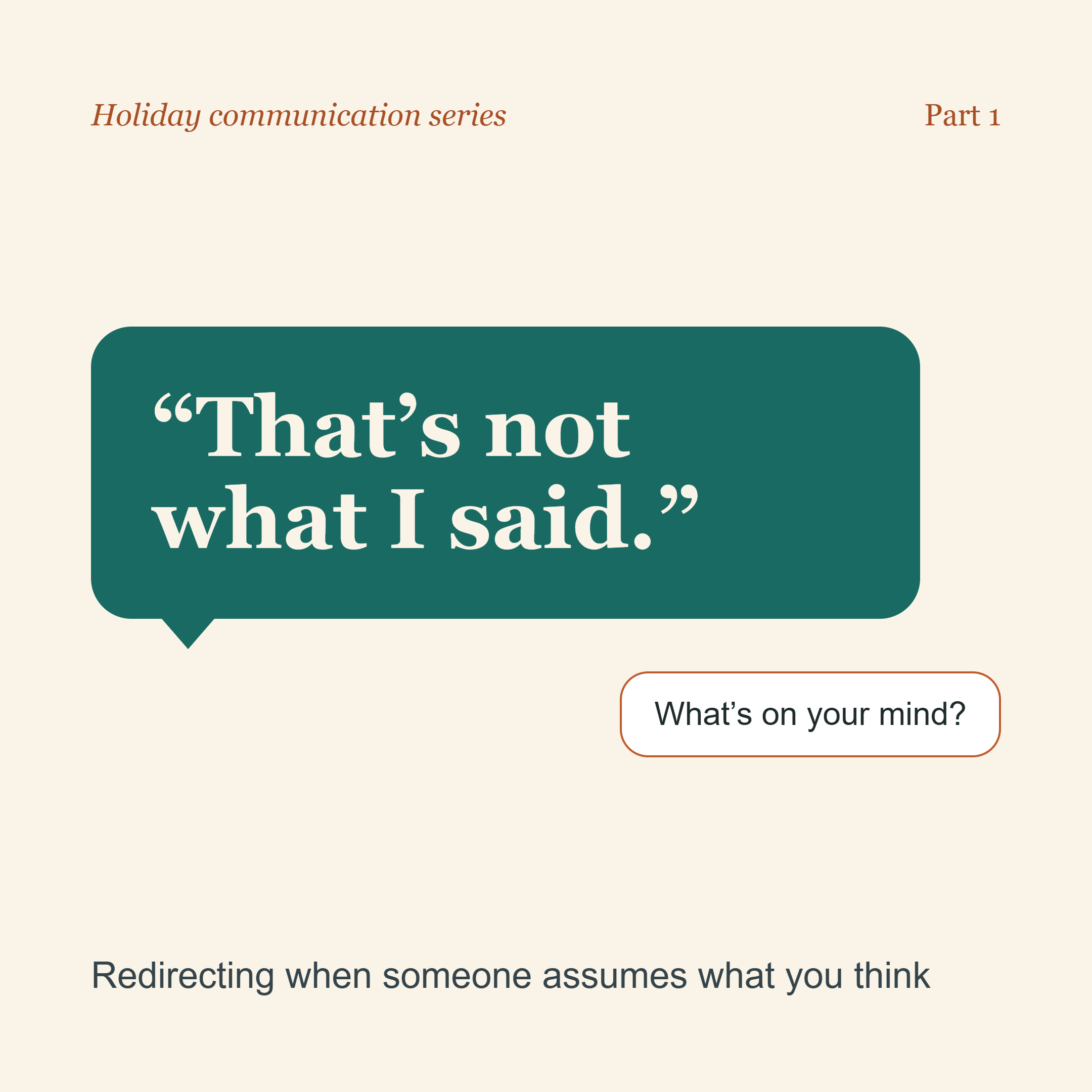
“That’s Not What I Said”: Redirecting When Someone Assumes What You Think
Part 1 of a holiday series on communication with the people we love most (and sometimes find hardest to talk to).
Your spouse is loading the car for Christmas at your in-laws’. Without looking up: “I know you hate my mother, but could you at least try this year?”
You don’t hate her. You may find her exhausting. You may still be sore about last Easter. But hate? Now you have a choice to make, and you have about two seconds to make it.
Most of us make the same choice: we defend. “I don’t hate your mother!” “Why would you even say that?” “You always do this.” Within a minute, the conversation is no longer about the visit. It’s about who is right about what you supposedly feel. And you haven’t even left the driveway.
This post is about a different choice. When someone tells you what you think or feel, without ever asking, you can redirect instead of defend. It’s a skill. Like any skill, it can be learned and practiced, and the holidays offer plenty of practice.
Why it stings so much
Being told what you think is a small act of trespass. Your inner life is yours. When someone narrates it for you, especially someone who knows you well, it can feel like they’ve walked into your house without knocking and started rearranging the furniture.
So we rush to correct the record. That urge makes sense. But notice what the correction does: it accepts the other person’s frame. Now there are two people arguing over a statement neither of you actually made. The assumption becomes the topic, and the real thing underneath it gets lost.
And there almost always is a real thing underneath it. “I know you hate my mother” is rarely a claim about you. More often it’s a window into your spouse. They may be anxious about the visit. They may feel caught between you and their family. They may be bracing for a repeat of last year. The assumption is a clue, not a verdict.
The question is whether you’ll follow the clue or fight the verdict.
The redirect: three moves
Communication coach Jefferson Fisher, author of The Next Conversation: Argue Less, Talk More (2025), makes a point I return to often with clients: the goal of a hard conversation is not to win it. The goal is to stay in control of yourself so the conversation can go somewhere good. Redirecting an assumption is a clear example of that principle at work.
1. Pause before you answer
Take one slow breath before you say anything. That’s it. The pause keeps your first reaction from becoming your only reaction. It also lowers the temperature, because a calm response is hard to argue with.
If you need a few seconds, buy them honestly: “Hm. Let me think about that for a second.”
2. Don’t accept the frame, and don’t attack it
You don’t have to agree with the assumption. You also don’t have to prosecute it. Simply decline it, calmly and briefly:
- “That’s not quite where I am.”
- “I don’t think that’s what I feel, but I can tell it’s on your mind.”
- “I can hear that you think I see it that way.”
Notice what these do. They correct the record in one sentence, without heat, and without turning the correction into a counterattack.
3. Get curious about the clue
Now follow the clue. Turn the conversation back toward the person, with genuine interest:
- “What makes you say that?”
- “Tell me more about that.”
- “It sounds like you’re worried about this visit. Is that right?”
Tone carries most of the weight here. “What makes you say that?” can be an invitation or an accusation depending on how you say it. Slow down. Soften your voice. Mean the question.
Once the other person feels heard, you’ll often get the chance to share what you actually think. Keep it short and honest: “I don’t hate her. I want this visit to go well, for both of us.” One true sentence, offered freely, does more than ten defensive ones.
Putting it together
Spouse: “I know you hate my mother, but could you at least try this year?”
You: (one breath) “I don’t hate her. But it sounds like you’re worried about how this visit will go. What’s on your mind?”
What to avoid
A few common responses feel satisfying in the moment and almost always escalate:
- The counter-assumption. “Well, you think I’m judgmental.” Now there are two mind-readers at the table.
- The cross-examination. “When have I ever said that? Name one time.” This turns your relative into a defendant.
- The global label. “You always do this.” “Always” and “never” invite the other person to argue the exceptions instead of hearing you.
- The over-explanation. A five-minute defense of what you really think. The longer the defense, the more it sounds like guilt.
When to let it go
Not every assumption needs a response. If it’s offhand, low-stakes, or said in the middle of a crowded kitchen, you can let it pass and return to it later in private: “Hey, earlier you said you thought I was upset about the move. I wasn’t, but I wanted to check in.”
And if someone repeatedly tells you what you think, refuses every invitation to talk, or uses assumptions to control or shame you, that is a different problem. Redirecting skills help in ordinary friction. They aren’t meant to carry a relationship that keeps causing harm. That’s a good thing to bring to a counselor.
The deeper reason
This isn’t only a technique. It reflects something true about people.
An old idea, going back to Aristotle and Aquinas, defines love as willing the good of another. When someone misreads you, defending yourself wills your own good: being right, being understood. Redirecting with curiosity wills theirs. It says, “You matter more to me than winning this point.”
The Letter of James puts it more plainly: “Let every man be quick to hear, slow to speak, slow to anger” (James 1:19). That’s still good counsel at a holiday table.
There’s freedom here, too. You don’t need the other person to understand you correctly in order to stay steady. Your inner life doesn’t change because someone guessed wrong about it. Knowing that makes it much easier to stay calm, stay kind, and keep the door open.
Try it this week
You don’t have to wait for Thanksgiving. Pick one low-stakes moment this week, with a coworker, a spouse, a friend, and practice the three moves:
- Pause for one breath.
- Decline the frame in one calm sentence.
- Ask one curious question.
That’s the whole drill. The more you practice it when the stakes are low, the more available it will be when your spouse brings up their mother on the drive over.
Coming next in this series
Over the next few weeks leading up to Christmas, we’ll look at more tools for holiday conversations: responding to unsolicited advice, staying steady when politics comes to the table, setting a boundary without starting a fight, and repairing a conversation that already went sideways.
When you want more support
Sometimes the patterns in a family run deeper than any single conversation. If the holidays bring up more than you’d like to carry alone, the clinicians at Mosaic Psychological Services are here to help. We work with individuals, couples, and families on communication, conflict, and the relationships that matter most. Contact us to schedule an appointment.
References
Aquinas, T. (1947). Summa theologica (Fathers of the English Dominican Province, Trans.). Benziger Bros. (Original work published 1265–1274)
Fisher, J. (2025). The next conversation: Argue less, talk more. TarcherPerigee.
The Holy Bible: Revised Standard Version, Catholic edition. James 1:19.